
Harrison County Court Records Path
Harrison County court records after a jail arrest are not the same thing as an arrest log. The local custody event starts when a person is arrested and booked into the Harrison County Jail, if local detention is needed. The court side starts when the case is filed in Iowa District Court for Harrison County. The prosecutor may file a complaint, trial information, or other charging paper after reviewing the facts. That filing is the point where the public court record begins to answer the filed-charge question.
The Harrison County Attorney is Sarah Delanty. Iowa uses county attorneys for county-level criminal prosecution, not district attorneys. The county attorney's office prosecutes state criminal law violations and county ordinance violations, and it also handles juvenile delinquency, child-in-need-of-assistance, and mental health commitment matters. For an adult jail arrest, the key point is simple: booking allegations may be known at the jail, but filed court charges come from the prosecutor's action in court.
Custody and booking questions still belong to the jail. Harrison County did not publish an official online jail roster in the research file, so current custody checks usually start with the jail phone or IowaVINE. Filed charges, docket entries, case numbers, hearing dates, and dispositions belong in Iowa Courts Online or the clerk's records. For current custody detail, use Harrison County jail inmate records. For booking photos, use the separate Harrison County jail mugshots page.
The Harrison County District Court page identifies the local clerk and court contact for county cases.
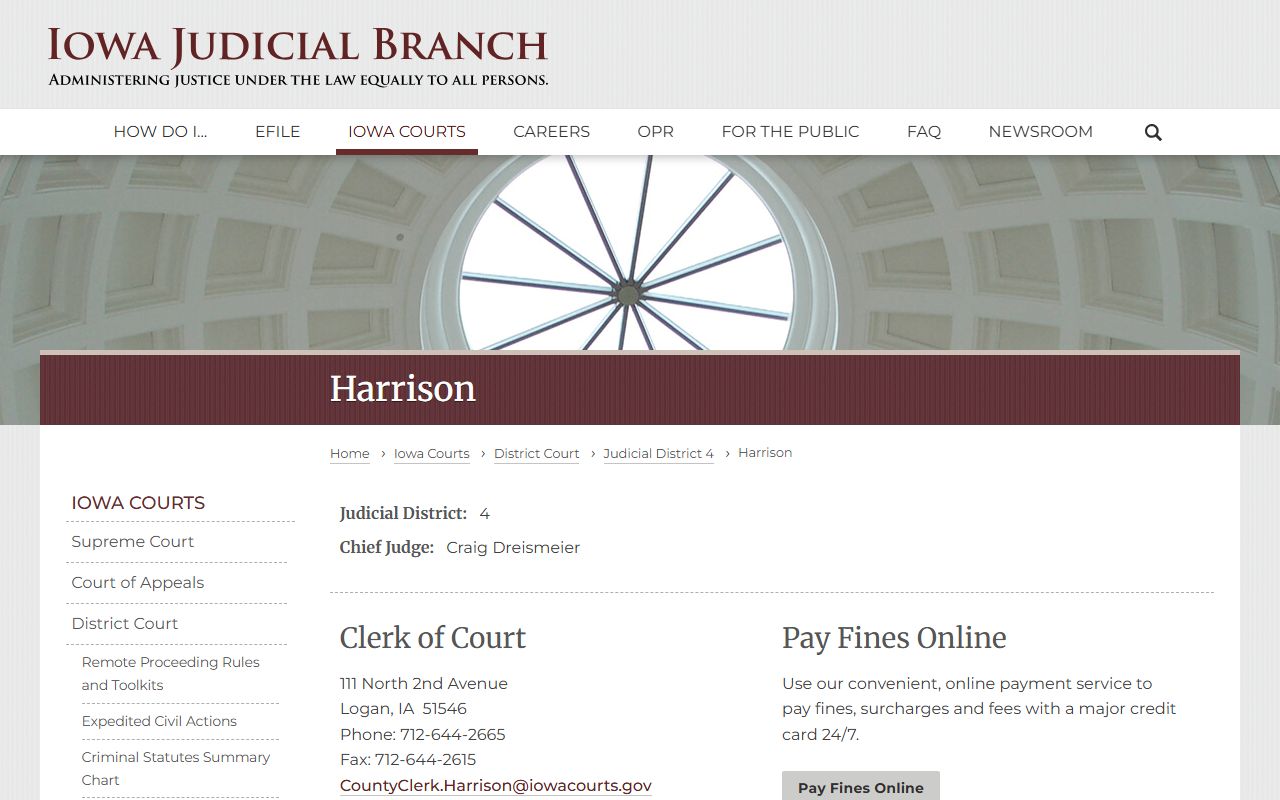
That court page is the local courthouse source for the clerk's address, phone, fax, email, case scheduling number, and Fourth Judicial District placement.
Find Harrison County Court Records
The public case-search path for Harrison County court records after an arrest is Iowa Courts Online. The system covers Iowa trial court dockets and lets a user search by name, date of birth, case ID, citation, and appellate fields. Public case information is free, although the research notes that some expanded information requires a subscription and public trial electronic documents may need to be viewed at a courthouse terminal.
- Open Iowa Courts Online and choose the search path that fits the information known, such as name, date of birth, case ID, or citation.
- Use Harrison County when the search asks for county or case ID context, then enter the defendant name or case number as accurately as possible.
- Open the public criminal case result and read the charge list, docket entries, court dates, bond entries, and disposition lines.
- Compare the filed charge with any jail booking allegation, because the prosecutor may file a different charge or decline one charge while filing another.
The Iowa Courts Online help guide gives search rules that matter in a small-county case lookup. A trial court name search needs at least two letters in the last or firm name. A date-of-birth search needs exact date of birth plus last and first name. A Case ID search uses county and case type, and the Case ID format is case-sensitive in the help notes.
The Iowa Courts Online search entry page is the matched public portal for filed Harrison County court records after arrest.
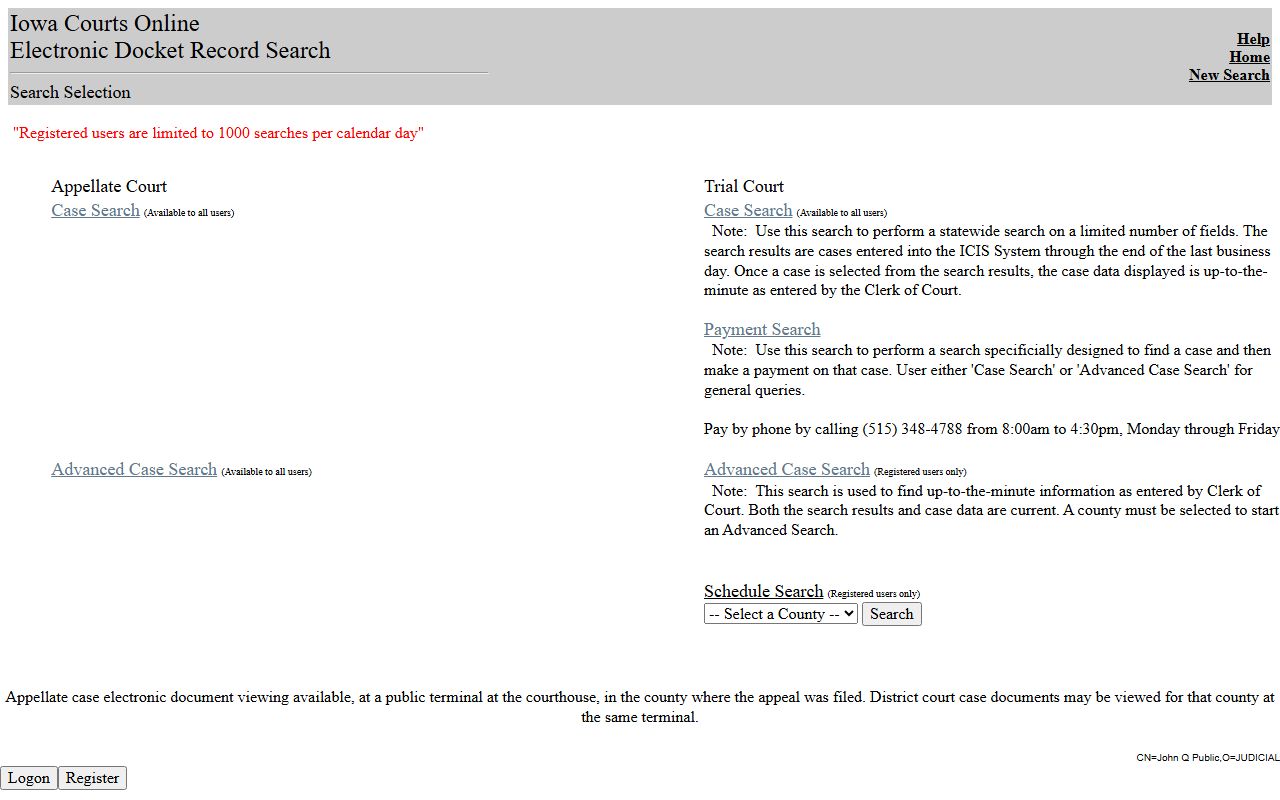
Use this court-search path for filed case records, not as a substitute for the jail when the only question is whether someone is still in custody.
Harrison County Court Search Fields
Iowa Courts Online search fields are useful when a Harrison County arrest has moved from booking into a filed criminal case. The table below comes from the Iowa Courts Online help material summarized in the research. It is especially useful when a common name returns too many results or when a case number was given at first appearance, by counsel, or by the clerk.
| Search type | Fields and requirements |
|---|---|
| Trial court name search | Last or firm name needs at least two letters. Other fields are optional. The help guide notes wildcard and AND/OR search options. |
| Trial court DOB search | Exact date of birth, last name, and first name are required. The first and last names cannot be wildcarded. |
| Trial court Case ID search | County and case type are required. A Case ID can be used when known, with capital letters in the required format. |
| Citation search | Enter the citation number when the arrest or charge was tied to a citation. |
| Appellate search | Search by appellate docket number, short case title, name, role, issue, case type, status, event, or filed date range. |
Public online docket information may include basic case information, case titles and filings, parties and lawyers, criminal charges, disposition entries, fine and fee information, and payment entries. Juvenile and other confidential case information is not available online. Public trial cases after 1998 are generally available online, while older or document-level records may require the Harrison County Clerk of Court.
Note: The clerk is the court-record custodian; the sheriff is the jail and booking-record contact.
Harrison County Charging Records
After a Harrison County jail arrest, the first public court record is usually tied to a charging document. Iowa research for this project names complaint, information, and indictment as key terms. A complaint is a sworn accusation or charging document used to begin a criminal proceeding. An information is a prosecutor-filed charging document. An indictment is a grand-jury charging document.
Those words matter because the jail may know an arrest allegation before the court case is fully open. Once Sarah Delanty or the Harrison County Attorney's Office files the charge, the court record can show the official charge level, code reference, hearing path, bond entries, and later disposition. A filed charge can be broader, narrower, or different from the booking label used at intake.
| Document | Who files or issues it | How it fits the court record |
|---|---|---|
| Complaint | Often tied to a sworn accusation before a magistrate. | Can begin a criminal proceeding and support arrest-warrant probable cause under Iowa law. |
| Information | Filed by the prosecutor. | Common prosecutor filing that sets out the formal charge the court will track. |
| Indictment | Issued through a grand jury. | Charging paper used in serious cases when the grand-jury route is used. |
Iowa Code 804.1 says a criminal proceeding may begin by complaint before a magistrate and, if probable cause appears, the magistrate may issue an arrest warrant. That is one reason the court record may include both warrant information and later charge filings.
Harrison County Charge Status Records
Charge status is one of the main reasons to search court records after a jail arrest. A booking event proves that the person entered custody. It does not prove that every listed allegation became a filed charge, stayed filed, or ended in a conviction. Iowa Courts Online is the better place to check whether a Harrison County charge is pending, amended, dismissed, disposed, or tied to a sentence.
| Status | What it usually means in a court record |
|---|---|
| Pending | The charge has been filed and remains active. Hearings, bond terms, or motions may still be ahead. |
| Amended or reduced | The prosecutor or court record reflects a changed charge, level, count, or wording from an earlier entry. |
| Dismissed | The charge was ended without a conviction on that count, though other counts or cases may remain. |
| Disposed | The charge has reached an outcome, such as plea, verdict, sentence, dismissal, or other court action. |
| Transferred or appealed | The record may move into another court level, another case number, or appellate tracking. |
A small timing gap is common. A person may be booked, released, or held before the public court case appears online. The reverse can also happen after sentencing, when a person leaves the county jail and later appears in the Iowa Department of Corrections offender search instead of a jail custody channel.
Harrison County Arrest Bond Records
Bond after a Harrison County arrest may appear in court entries, jail custody notes, or both. The research did not locate a Harrison County sheriff online bond-payment page, so local bond questions should be verified through the jail, the clerk, or the court docket. The Iowa Judicial Branch publishes a Uniform Bond Schedule, but that schedule has limits.
The schedule applies only when a person was arrested for a non-forcible felony crime and courts are not in session. After the person appears before a judicial officer, the judicial officer sets bond under Iowa Code 811.2 and is not bound by the schedule. Some arrests cannot use the schedule before a judge acts, including forcible felonies, certain methamphetamine offenses, stalking, protective-order-related custody, intimidation with a dangerous weapon, and felon-in-possession.
| Offense level | Uniform schedule amount |
|---|---|
| Class B felony | $25,000 |
| Class C felony | $10,000 |
| Class D felony | $5,000 |
| Aggravated misdemeanor | $2,000 |
| Serious misdemeanor | $1,000 |
| Simple misdemeanor | $300 |
Cash bond means money is paid to secure appearance. Surety bond means a surety or bail agent backs the bond where allowed. Personal recognizance, often called PR or own recognizance, means release based on the person's promise to appear. A no-bond hold means release is not available until a judge acts or another hold changes.
Note: The Iowa Courts ePayment search is documented for fines, court debt, and some citations, not as a confirmed Harrison County jail bond portal.
Harrison County Warrant Records
No official Harrison County online active-warrant search or warrant list was located in the research. That gap matters because a warrant can be the reason a person is arrested, booked, held without immediate release, or required to appear before a magistrate. A bench warrant may appear within an existing public court case when the case is not confidential. A sealed warrant, juvenile matter, or active investigation may not be visible online.
Iowa Code 804.21 addresses appearance after arrest on a warrant and requires the person to be taken without unnecessary delay before the nearest or most accessible magistrate. Iowa Code 804.22 covers initial appearance after a warrantless arrest. The Iowa Judicial Branch guide also notes that magistrates can issue search warrants and conduct preliminary hearings. In practical terms, warrant status may require a mix of sheriff contact, clerk contact, court search, and legal advice.
For Harrison County warrant questions, use the Harrison County Sheriff's Office at the Law Enforcement Center for local law-enforcement routing and the Harrison County Clerk of Court for public court-case questions. If the arrest involves another county, Iowa DOC, federal custody, immigration custody, probation, parole, or a detainer, one bond entry may not resolve the whole custody issue.
Charge vs Conviction
A charge is not a conviction. A charge is an allegation filed in court after arrest and prosecutor review. A conviction is the result of a guilty plea, verdict, or other final finding that creates a criminal judgment. This distinction is critical when reading Harrison County court records after an arrest, especially if a booking entry, charge line, and final disposition all use different language.
| Record point | Charge | Conviction |
|---|---|---|
| Stage | An accusation filed or pursued in court. | A final outcome after plea, trial, or court finding. |
| Proof level | May be based on probable cause or prosecutor filing judgment. | Requires proof beyond a reasonable doubt or a valid guilty plea. |
| Case effect | Can be pending, amended, reduced, dismissed, or disposed. | Can lead to sentence, fine, probation, jail, prison, or other court order. |
| Search caution | Do not describe a pending charge as guilt. | Check the disposition and sentence entries before relying on the result. |
Sealed vs Expunged Records
Iowa public access rules do not make every court record or jail record visible to every user. Juvenile matters and other confidential records are not available online through public case search. Iowa Code chapter 22 gives access to public records unless another law restricts them, while Iowa Code 22.7 lists confidential categories, including peace officer investigative reports and criminal-identification limits.
| Access term | What it means for public search | Harrison County arrest context |
|---|---|---|
| Sealed | The record is hidden from ordinary public access, though court or law-enforcement access may remain under law. | A public search may not show the case, document, or detail even when an arrest once occurred. |
| Expunged | The record is removed, destroyed, or treated as no longer public under the specific expungement rule that applies. | Eligibility depends on the disposition and Iowa law, not on a private search result. |
| Confidential | The record is restricted by statute, court rule, or case type. | Juvenile, sealed, investigative, medical, safety, and certain personal data may be withheld or redacted. |
A dismissed charge may still leave traces in some systems until the correct legal step is taken, and not every dismissal creates automatic expungement. Anyone trying to clear or limit access to Harrison County court records after arrest should rely on the court, clerk, counsel, and Iowa law rather than assuming a web search controls the official record.
DCI Criminal History Checks
Iowa DPS and the Division of Criminal Investigation provide a separate criminal history record check channel. That is useful when the question is broader than one Harrison County court case. The research notes DCI request options by online, mail, fax, email, and in person, with a $15 fee per last name. It also notes that DCI does not take phone requests.
The DCI path is different from Iowa Courts Online. Iowa Courts Online is a case-search and docket-search tool. DCI criminal history is a statewide criminal-history request channel with its own request form, fee, and release limits. Court records after a jail arrest may show charges, hearings, and dispositions in one case, while DCI may be used to check criminal-history information more broadly.
The Iowa DPS/DCI criminal-history page is the matched state source for official criminal-history requests.
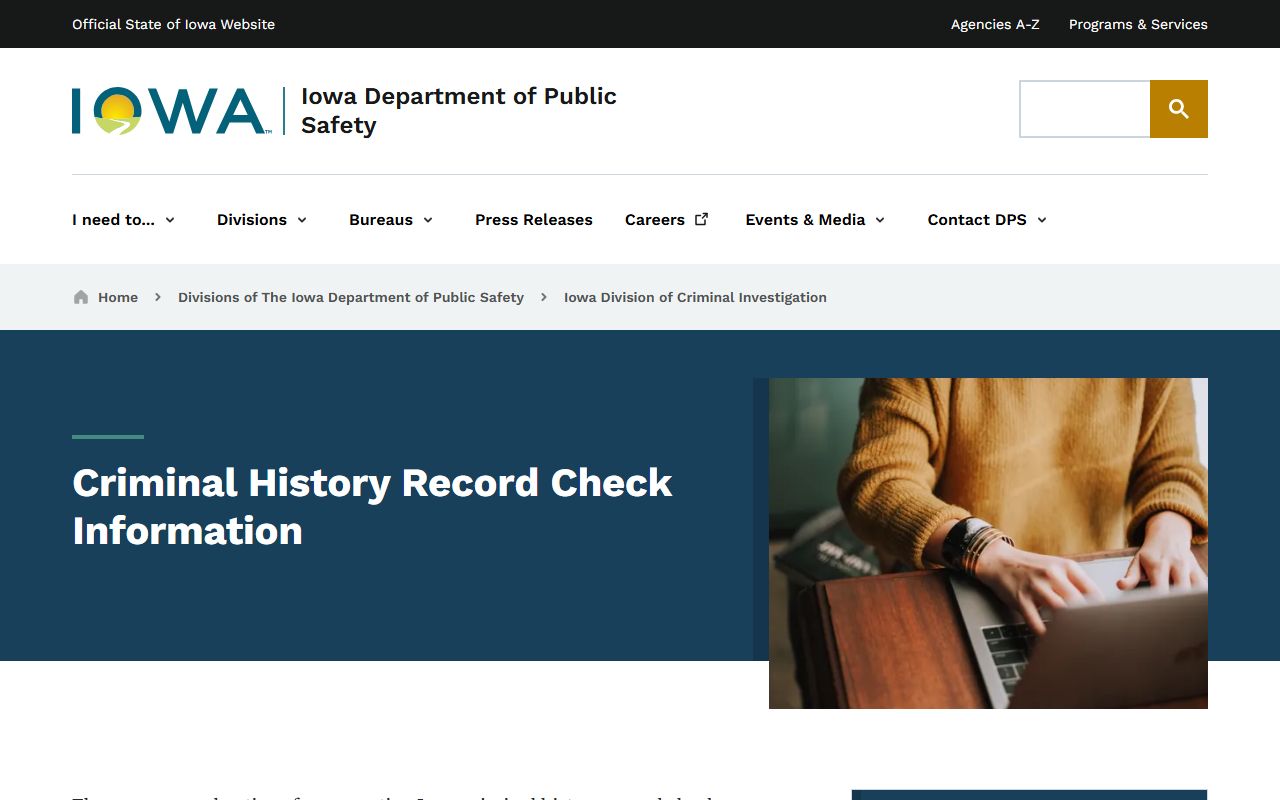
Use DCI for a state criminal-history request, and use Iowa Courts Online or the clerk for the Harrison County court record tied to a specific arrest.
Important: Search results must not be used for credit, employment, insurance, tenant screening, or any FCRA-regulated decision.
Restricted Harrison County Court Records
Some court records after an arrest are public, some are partly public, and some are restricted. Iowa Judicial Branch public access notes say juvenile and other confidential case information is not available online. The research also notes that public trial electronic documents may be viewed for that county at courthouse public access terminals, while some schedules, judgment index, lien index, exhibit lists, bonds, and service returns require paid subscription access.
The Harrison County Clerk of Court is at 111 North 2nd Avenue, Logan, IA 51546. The clerk phone is 712-644-2665, the fax is 712-644-2615, and the email listed in the research is CountyClerk.Harrison@iowacourts.gov. For public-records policy on court records, the Iowa Judicial Branch also publishes a public records request page. For jail booking records, mugshots, and local custody questions, the lawful custodian may be the sheriff instead of the court.
Iowa Code 22.2 gives a right to examine and copy public records unless another law restricts access. Iowa Code 22.3 allows reasonable expenses for services and copies. Iowa Code 22.7 is the main caution list for confidential records, including investigative material and some criminal-identification information. In a Harrison County arrest matter, those rules can affect what is shown online, what must be requested from the clerk, and what the sheriff may redact or withhold.